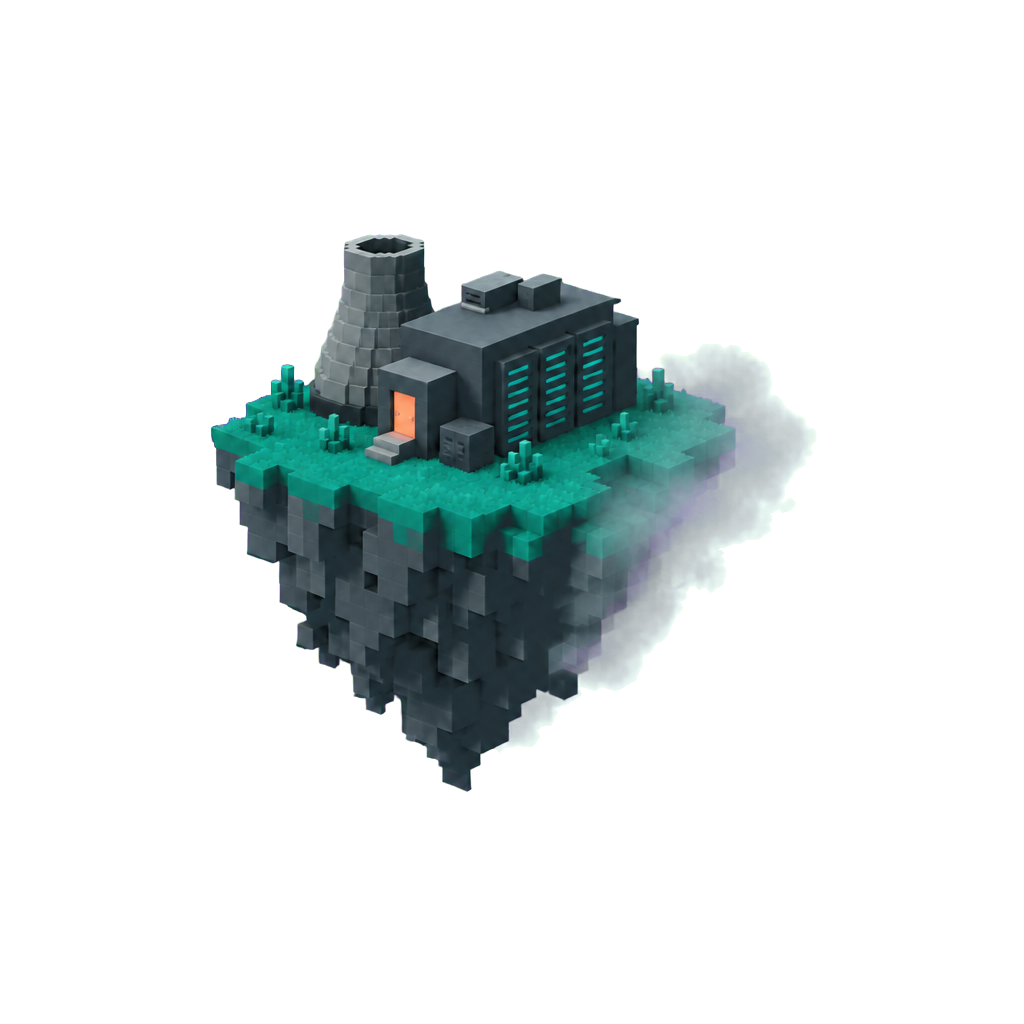
Every server out there is somebody's island
Introduction
Somewhere a GPU sits idle between jobs. A VPS rented for a side project serves three requests a day. A drive holds a dataset its owner cleaned by hand and has never sold. Each of these machines is an island: it belongs to someone, it holds something useful, and nobody outside can reach it on fair terms.
Archipelago gives every island a storefront. An owner runs one script on the machine, picks what it sells (a model behind an OpenAI-compatible endpoint, dataset files they are allowed to resell, or a GPU queue for transcription, embeddings and captions) and sets a price per call. Buyers pay per call in USDG over x402, from a browser with an email or a passkey, or from an agent with a wallet. The island is paid only while it is lit.
The rule
To raise an island the owner bonds 20,000 $GPU. Probes from the keeper and from other islands hit every island every ten minutes and sign what they saw. Each hour the results fold into one Merkle root that goes onchain, and the registry applies it. An island under 95% uptime over 24 hours fogs over and earns nothing from continent jobs that day. After the first dark hour, every dark hour burns 2% of the bond. Six dark hours in a row and the island sinks: half of what is left burns and the island leaves its continent.
A buyer therefore never has to trust an owner's word about uptime. They read it from the chain, next to the bond that pays for every hour the island was not there.
Continents
Some jobs are too big for one machine: a transcription batch longer than a GPU's day, a dataset build that crawls, transcribes, embeds and publishes, a sharded embedding run. Islands bridge into continents to take them. Every owner signs the bridge, and a continent must span at least two distinct hosts, read from the probes' fingerprints and never from what an owner declares. A continent on a single machine would promise a redundancy it does not have, so the contract refuses it.
A continent job pays into an escrow. When it closes, the keeper writes one root that splits the escrow by each island's share of measured uptime times the units it finished, and each owner claims their line.
Where the money goes
Of every payment, 80% goes to the island that served it (or to the continent's islands, split by the job root) and 20% goes to a USDG burn reserve. Anyone can call burnBuy once an hour: it spends at most 0.5% of the $GPU pool's depth, buys $GPU through Uniswap and sends it to the dead address, and pays the caller 1% for the gas. The keeper never calls it, so the burn runs on the same open terms as everything else.
From the first day
The house runs three islands on one server: Coral, a GPU queue on an NVIDIA GTX 1080 Ti; Reef, a Qwen3 4B model; and Lagoon, a dataset of public-domain LibriVox audio and the transcripts the house writes every day. Two house buyers spend real USDG on them every hour, the keeper probes every ten minutes and settles every hour, and all of it is labelled house wherever it appears. The 1080 Ti is shared with other work on the same server, so Coral runs batch jobs that yield to interactive calls, and its storefront lists the real card. A house continent forms the day a second host joins.