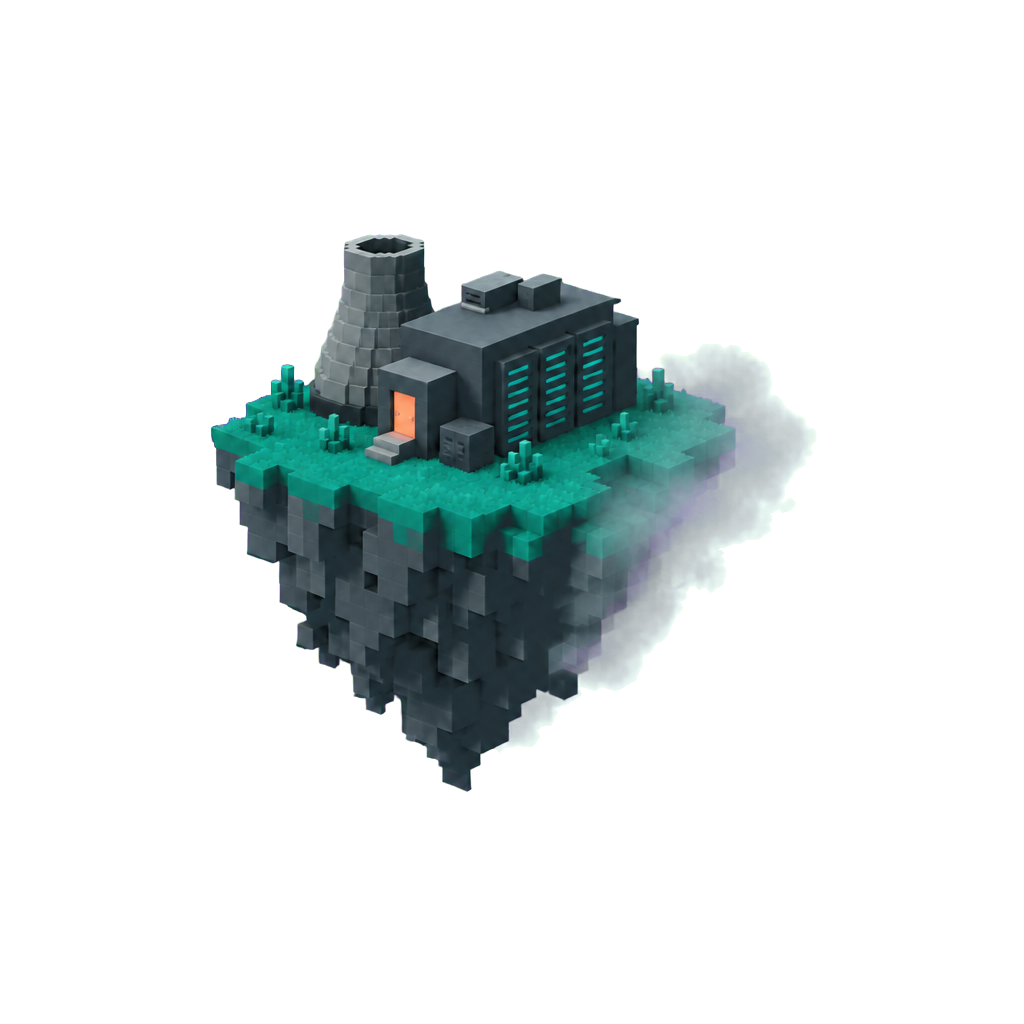
The sky map
How an island grows
The home page draws every island on the ledger as a floating voxel island. Its size comes from one number, its growth points: 250 for each distinct renter, 50 for each rental and 1 for each call. Renters and rentals are read from the Crown's Rented events (one per rental settled through the Meter), calls from the Meter's Receipt events, rentals excluded. One cabin with a coral window stands on the rim for every distinct renter, up to twelve, and each renter widens the land. When an island crosses a tier, the map plays the growth: the island swells, a ring of light goes out from it and the HUD names the new tier.
| Tier | Growth points | What the island gains |
|---|---|---|
0, Raised | 0 | The centrepiece with one floor, two racks, the base rock |
1, Outpost | 1 | A rack row in the yard and the first tower |
2, Station | 25 | A second floor, a second tower, more land |
3, Hub | 100 | A third floor, a two-row rack yard, a deeper rock |
4, Foundry | 500 | A fourth floor, a second hall, four towers, wider land |
5, Citadel | 2,500 | A fifth floor, six towers, a ring of rack yards |
6, Capital | 10,000 | A sixth floor and the widest land an island can hold |
A single renter is worth 250 calls, so an island rented by four different people for an hour each (4 x 250 + 4 x 50 = 1,200 points) stands at Foundry, where calls alone would need 1,200 paid requests.
When a call or a rental settles, the island's racks flash, its towers steam harder, a beam rises from the island to the Meter and a spark comes back down the chain that links them. These animations replay real settlements read from the chain every 30 seconds; nothing on the map is simulated.
Shaped by the GPU
Each island is drawn from the GPU its host reports (see hardware reports): a GeForce island is a graphics card the size of a hall lying on a lit riser, its fans spinning while it serves; a data-center island is a low slab under gold SXM boards; an AMD Instinct island is a red monolith with stacked chiplets; an Apple island is an aluminium dome; an island without a GPU is a shed. An island whose host has not reported yet keeps the plain data hall.
Visiting an island
Every island has a visit link, /islands/<name> or /islands/<id>. Opened from outside, it lands you walking on that island in front of its door. Other people on the same island show as walkers in their own colour, moving where they walk; people who only have the island open stand near the door. The map polls every four seconds; your position goes to the gateway with an id made in your browser tab, is kept twenty seconds and then forgotten. No cookie is set and no address is kept.
Unclaimed plots
Most of the rocks in the sky are unclaimed plots: bare turf, trees and sometimes a spring, with a survey stake and nothing built. They are not islands, they carry no name and no data. Hovering one shows "Unclaimed: raise an island here" and clicking it opens the raise panel. When a new island is raised, it takes its place on the spiral around the Meter and any plot under it gives way.
The ring of pylons to the south west is the continent zone. It stays empty until islands on distinct hosts join a continent; members then gather inside it.
Getting around
| Mode | Desktop | Phone |
|---|---|---|
Map | Drag to move, right drag to turn, scroll to zoom, 0 frames everything | Drag to move, pinch to zoom |
Fly | F or the Fly button. Click to steer with the mouse; W S thrust, A D strafe, Space up, C or Ctrl down, Shift boost; L lands on the island under the ship | Left stick to fly, drag to look, Up, Down and Boost buttons |
Walk | W A S D, mouse to look, Space jumps, Shift runs, F takes off | Stick to walk, drag to look, Jump, Take off |
Scan | E: islands in range show their GPU, tier, renters, calls and USDG earned; plots show as unclaimed | Scan button |
Clicking an island in the islands list or on the minimap travels there: the camera in map mode, the ship on autopilot in fly mode. On a claimed island, the teal pad in front of the hall throws the walker to the nearest island.
Performance
Each island is one mesh: a voxel grid meshed to its visible faces only, with ambient occlusion baked into the vertex colours, so the whole sky draws in a few dozen calls. Distant plots switch to a half-resolution mesh. Clouds, waterfalls, chains and stakes are one instanced draw each. The shadow map covers only the area around the camera. Light shafts, the scan wave, tone mapping and grading share a single full-screen pass; bloom and multisampling are off on phones. The renderer measures its frame rate every second and lowers the pixel ratio when frames run slow, then raises it again when there is headroom. The map loads after the page has painted and builds the plots a few at a time between frames.
Browsers without WebGL2 get a flat plan of the same islands and a list read from the same ledger.
Credits
The map is drawn with three.js (MIT licence). Every model, texture and sky on it is generated in code at load time; no third-party art assets are used.